
Strategic guidance for water sector leaders

Over the past several months I’ve written a series advancing five pillars of affordability: broad principles to guide affordability policy for leaders of America’s water and sewer utilities. These pillars are my way of organizing and distilling the body of available empirical research on water affordability in the United States, along with my own observations in 25 years of working with utilities large and small.
These pillars work within the existing legal, political, and organizational constraints under which American utilities operate. That is, I assume that water systems continue to rely primarily on rate revenue and that water/sewer utilities will continue to be owned and operated by a mix of municipal governments, special districts, investor-owned firms, and nonprofit cooperatives. I make no calls for Congress to spend a trillion dollars, to nationalize water systems, or to eliminate metered water service in favor of tax-funded free water.
Instead, my goal is to give utility leaders, policymakers, and advocates a practical way to think about and manage affordability, right here and right now. Each of the five complements the others, and although some are more important than others, none is sufficient on its own. As with a structurally sound building, multiple pillars must share the affordability load. Leaders who build their affordability strategy on these five pillars can be confident that they are doing the best that they can based on what we know today.
This post summarizes the five pillars, presented in general order of importance (click headings for the full post on each).Pillar One: Quality
Providing and maintaining high quality service is the first and most important thing any utility can do for affordability—because poor service quality drives customers to vastly more expensive bottled water.
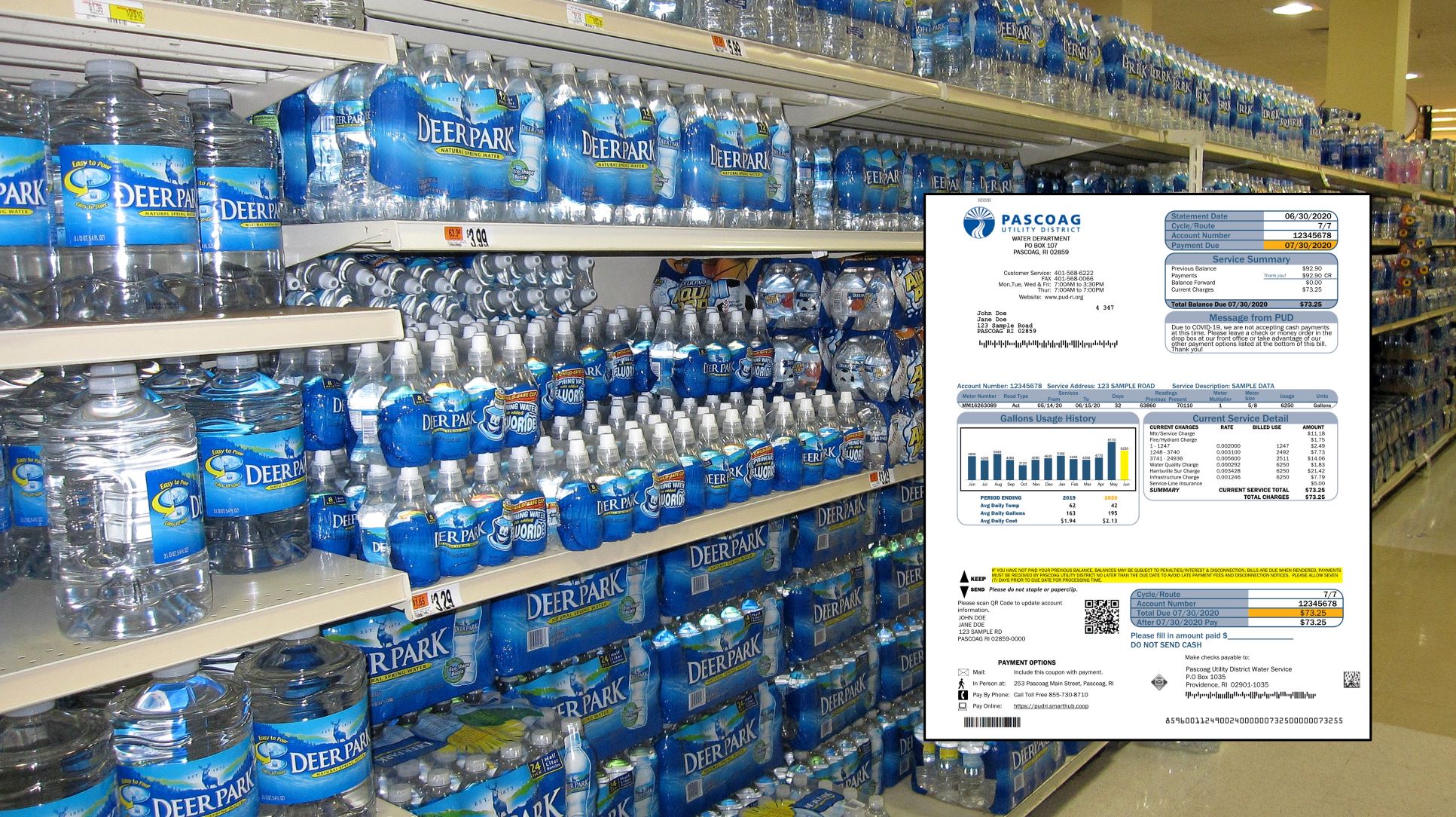
Gotta count the bottle and the bills
Voluminous research shows that bottled water is most popular among low-income households and that concern over tap water quality is a principal reason that consumers choose to drink bottled water. When we consider affordability not in the narrow terms of utility bills, but rather in terms of total household expenditures on water, it becomes clear that affordability starts with quality.
A devotion to quality sometimes requires charging higher prices to support sound infrastructure and excellent operations. What’s more, educating the public about the quality and value of tap water is part of an effective affordability strategy. A commitment to quality pays off in affordability for customers who can confidently consume tap water and so avoid spending orders of magnitude more for commercial alternatives.
efficient water systems with this one weird trick
Pillar Two: Efficiency
The second pillar of affordability is efficiency: operating at the lowest average cost possible without sacrificing quality. More than cost-cutting, efficiency requires utilities to deliver excellent service with low rate revenue requirements—with attention to the costs that matter most and the value that their systems provide.
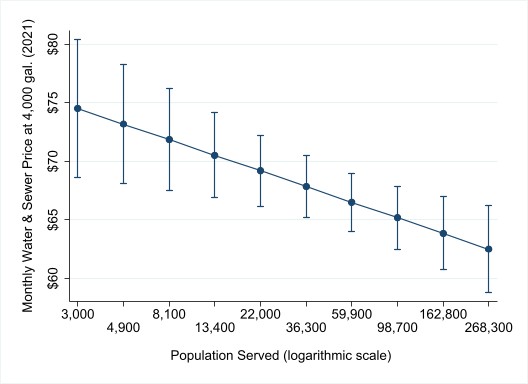
The single greatest factor that drives down a water utility’s average cost is scale, so consolidation is one of the most important ways to address affordability. Since efficiency also implies value, utilities also must take aesthetics (taste, odor, color) seriously, offer great customer service, maintain attractive facilities, and provide public education. Municipal governments should eliminate taxes on residential water and sewer service.
Pillar Three: Rate Design
Service prices can be higher or lower for the same volume of water, depending on the rate structures that utilities employ, and so can significantly affect the relative burden that utility service costs place on low-income customers.
Inclining block structures with low fixed charges, modest prices for low volumes, and steeply inclining prices at higher volumes help affordability.

Water Tango Foxtrot
Volumetric sewer prices and stormwater charges pegged to impervious surface areas are similarly good for affordability. Low fixed charges and inclined block rates allow customers greater control over their bill so price-conscious customers can adjust their water consumption to reduce their overall expenditures.

When things get hot, coverage matters more than fit
Pillar Four: Income-qualified assistance
(parts one, two, three, four)
Income-qualified customer assistance programs (CAPs) form the fourth pillar of affordability. Simplicity is the key to an effective CAP. For example:
- Rather than formulating complicated eligibility schemes, simply declare that participants receiving any other public assistance are eligible for the water/sewer CAP.
- Avoid complex, tailored benefits schemes and instead simply set a percentage or dollar benefit level that would help most customers and give the same benefit to every participant.
- Keep administrative costs low because most CAPs serve only a small minority of the eligible population so every dollar spent on administration means higher bills for poor and working-class customers who don’t participate. Administratively costly CAPs can hurt more customers than they help.
- Minimize the paperwork and processes required by the customer to participate.

good vs. evil at the water meter
Pillar Five:
Delinquency Management
As long as utilities operate on a fee-for-service basis there will be residential customers who fall behind on their bills. How utilities manage residential delinquencies determines whether personal finance problems become public health or environmental problems.
Residential shutoffs for nonpayment betray a utility’s core mission; we should eliminate them. We also should eliminate fees and penalties for late payments, shutoffs, and service restoration. At the same time, tolerating nonpayment threatens a utility’s sustainability. Instead, utilities should use property tax or real estate liens to secure payment. Liens allow utilities to fulfill their service missions to every customer while maintaining their financial sustainability. In a world of bad alternatives, property liens are probably the least bad.
Toward strategic affordability
Ensuring that essential water and sewer services are affordable for every customer is a strategic challenge. No single program is sufficient to meet this challenge; it’s a complicated problem that demands a comprehensive strategy with every tool at our disposal.* Strategy built on these five pillars is the best practicable path toward affordable water in America.
*Much of the advice in the great Water Affordability Advocacy Toolkit that NRDC published last year fits nicely under pillars 3-5.
Hello, I live in an HOA community in North East Ohio. Our community recieves waste water sewer service from a private sewer authority that has suddenly and on no justifiable grounds, reformed its customer bill delinquency policies into a vehicle of punitive extortion. The company has been targeting struggling housholds with the forced installation of a modified backflow valve that incorporates a plunger style service shutoff valve. The cost of installation is priced at 3500 dollars that is billed to the customer. The company has also implemented a late fee schedule that is listed as 10% of the past due balance and they calculate it on a compound interest formula that has made the late fee cost hundreds of dollars on the average delinquent bill. The company has never not been paid for a delinquent balance and there's long standing and proven methods used to recover delinquency payment that exist statewide. The company uses the modified valve to physically shut off residential sewer lines. They don't notify the water providing authority or bother to shut off water services, which is the key component of collective measure that's deployed when longterm outstanding sewer bill delinquency becomes issue. They also place a property lien on the premises.
The company now targets people with the valve shutoff and they offer no mechanism for payment plan or debt relief options. They refuse to restore service until the full delinquent balance, along with the exorbitant late fee, and a 50.00 late fee are paid in full. The compound interest generating late fee schedule never stops as they continue adding the charge to the delinquent account each month and even after service has physically been disconnected. The disconnect valve in its intended use guarantees massive property damage will occur to the effected building. It guarantees health and safety regulations are unavoidably breeched, and it violates civil rights based on denial of due process. It's basically a violation of basic moral human decency and causes direct intentional harm against those whom they have targeted. The community is on a quest to find answers and accountability, but due to the complexity of issues, as of date, there's no guidance locally available willing to address this outrageous and egregious company policy.