
Sometimes there’s a little to say about a lot of things. Welcome back to Variable Flow.

u can haz assistunce
A tale of two memos
EPA Office of Water recently released a memorandum outlining its priorities for technical assistance to the nation’s water systems: RealWaterTA. Promising to get “back to the basics,” the RealWaterTA memo appeared almost exactly three years after the Biden administration’s memo announcing its WaterTA implementation guidelines. To the uninitiated, the two four-page memos might look like they’re talking about the same thing: help for struggling small water and sewer systems.
A bit of lexical analysis, however, reveals a deep philosophical change in EPA’s approach. The 2023 WaterTA memo’s language is right out of the community development handbook, rife with words like “collaborate,” “engagement,” and “capacity.” The 2026 RealWaterTA memo leans heavily on command-and-control regulatory language like “health,” “systems,” “operations,” and “risk.” The word “collaborate” appears fifteen times in WaterTA (2023) and just once in RealWaterTA (2026); the word “compliance” appears fifteen times in RealWaterTA but just once in WaterTA.
I’m no linguist, but this word frequency graph seems to tell a story:
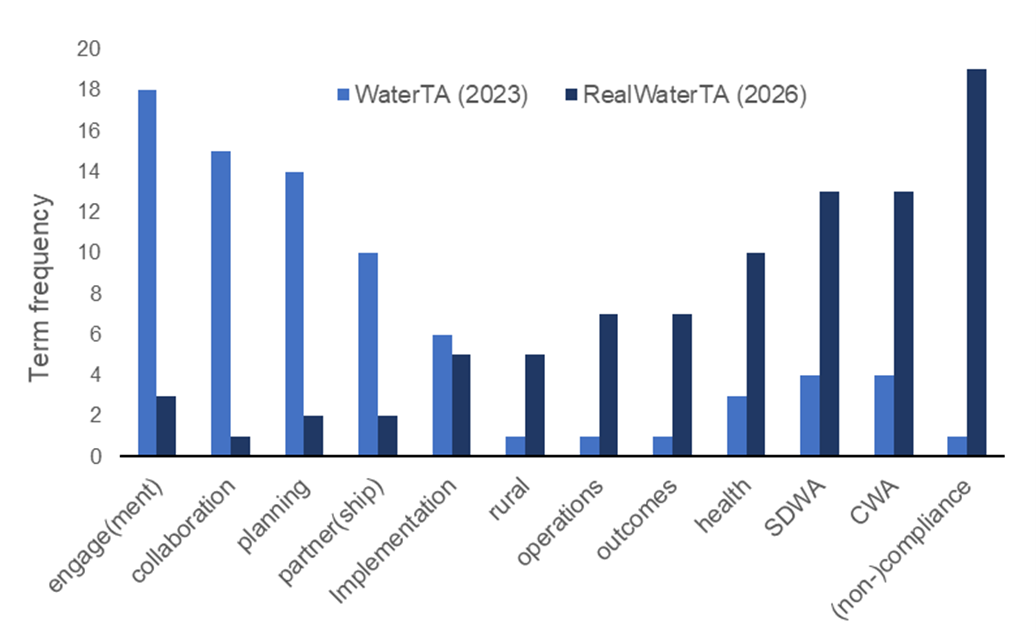
These aren’t stylistic quirks—the word counts reflect two very different theories of technical assistance, and they map cleanly onto the shifting priorities of the administrations that issued them. Under WaterTA, technical assistance looks like community development: lots of engagement, planning, capacity‑building, and organizing local leaders. With RealWaterTA, technical assistance looks more like regulatory triage: diagnosing noncompliance, fixing operational problems, and documenting measurable results. That’s quite a tactical pivot, and we haven't yet seen what that will look like on the ground. Personally, I hope that TA providers work themselves out of a job by making every water and sewer utility fully self-sufficient.

teh billz is too dang hi
That’s a terrible idea
This year’s Wisconsin gubernatorial race is shaping up to be a doozy. Republicans have consolidated around Congressman Tom Tiffany, but Democrats are locked in a nine-candidate battle royale. DSA-endorsed Madison Assemblywoman Francesca Hong leads the fragmented field; former Lieutenant Governor Mandela Barnes close behind.
Affordability is the word of the year in American politics, so it makes sense that the Barnes campaign sought to shore up his left flank with a plan to freeze utility rates in the Badger State. Among other things, Mr. Barnes pledged to appoint utility commissioners only if they promise never to approve utility rate increases.
“That’s a terrible idea,” I told the Milwaukee Journal-Sentinel. For starters, it’s probably illegal. But more importantly, precluding any and all rate increases undermines the core purpose of an independent regulator: the Public Service Commission is supposed to evaluate utilities’ costs and set rates at levels sufficient to ensure sound service for customers. When costs go up, rates have to go up, too—or else service quality and reliability will suffer. Ain’t no free utility lunch.
Drawing utility regulation into electoral politics is especially bad here in Wisconsin, where municipal water utilities are also regulated. Mr. Barnes’ fight seems to be with the state’s three big energy companies; it seems not to have occurred to him that his “no rate increase” commissioner’s pledge would also hammer the state’s 572 regulated water utilities. Denying those rate increases would invite disaster. It’s a good reminder that water utilities can catch stray bullets when politicians attack energy companies.
Rather than backing off or arguing the merits of its ideas, the Barnes campaign doubled down, misquoted, and then attacked me ad hominem. Whatever, man. Mandela Barnes actually seems like a decent guy; he’s also smart enough to know that this proposal is absurd.

we haz a mad
Protecting consumers with higher rates
Speaking of rate regulation, conventional wisdom says that regulatory commissions protect consumers by limiting utility rate increases. Standard economic theory says that, in absence of regulation, a monopolist will maximize prices to extract maximum profit from hapless consumers—hence regulation. Under regulation, utilities earn a profit on their capital investments, so the canonical Averch-Johnson model predicts that utilities will over-invest (or “gold-plate”) their systems as a means of maximizing profits. One of a regulatory commission’s main jobs is to scrutinize utility capital investments to protect against over-investment.
Less obvious but just as bad for consumers is the danger of underinvestment. Presenting a rate case before the commission is onerous, costly, and a little scary for smaller utilities—and rate increases irritate customers. So in many instances the utility owner is better off putting off rate increases, even if underinvestment threatens service quality, reliability, and sustainability. Following these incentives, many utilities run their systems to the brink of failure, as customers of 73 Arizona utilities recently discovered. As many as 50 small utilities in the Grand Canyon state have not raised rates for more than 20 years. When dire circumstances finally force investments, prices can double or triple overnight.
That’s not just an Arizona problem. Here in Wisconsin, the PSC recommends that utilities file a rate case every 5-7 years, but a 2024 report found that 35 Badger State utilities had not filed a rate case in this century. Importantly, that report found no relationship between average service quality and frequency of rate case filing: sometimes utilities are slow to raise rates because their systems and finances are fine. But a utility going more than a decade without raising rates ought to raise eyebrows. Regulators need to think about infrastructure conditions and financial sustainability as central to their mission because when it comes to consumer protection quality matters as much as prices. That might involve forcing a utility to file a rate case… and maybe even raise prices.

i can haz data?
Sanctuary utilities?
A friend who leads an Oregon utility told me about efforts in his state to block the U.S. Immigration & Customs Enforcement (ICE) agency from using utilities’ customer records, prompted in part by rumors that ICE agents had posed as utility workers in an effort to lure people out of their homes. The darkest, ugliest days of immigration enforcement action are thankfully in the rearview mirror (at least for now), and ICE is under more responsible leadership. But these incidents raise fundamental questions about a utility’s relationship with its customers and its role in civic life. Water/sewer utility leaders increasingly find themselves in the unfamiliar and uncomfortable position of being drawn into law enforcement action. This is uncharted territory.
My take? Law enforcement, including immigration enforcement, is critical for a functioning society; water is, too. Water and sewer utilities provide essential services that build, maintain, and rely on public trust—they should not become coercive instruments of government power. That’s why I’m against water taxes and against using shutoffs to compel payments unrelated to utility service. To protect privacy, utilities should minimize the amount of personal customer information they maintain (one good reason not to collect data on incomes or the number of people who live in a home, for example) and share identifying information only when absolutely necessary. With familiar caveat that I'm not a lawyer, as a practical matter, utilities ought to share customer data with law enforcement agencies only when a judicial warrant compels it.
It’s probably time for the water sector’s alphabet soup organizations (AMWA, AWWA, NACWA, NAWC, WEF) to establish an industry-wide policy on this issue before it flares up again—as it surely will.

i can haz samplez?
Kontaminated Kiosks
The Profits of Distrust analyzed the meteoric rise of commercial drinking water: bottled water and vending machines that promise a safer, tastier product than what flows from the tap—and disproportionately exploit low-income and ethnic minority consumers. Diving deeper, my Profits coauthor Samantha Zuhlke, Iowa professor David Cwierty, and their team gathered samples from twenty water kiosks across the Midwest and tested them for common contaminants. Their new peer-reviewed article shared the eye-opening results: lead was detected in fifteen of the twenty sampled kiosks, with five exceeding recommended levels for pediatric health and one exceeding the EPA’s action level. Tap water from nearby sources showed no such contamination. The Iowa team thinks that the reverse osmosis the kiosks use to remove fluoride, disinfectant residuals, and minerals also lowers the pH in ways that caused the kiosks’ metal parts to corrode and release metals into the final product.
“Our findings demonstrate that kiosks’ marketing claims do not always reflect the product they deliver,” the study concludes. “In some cases, consumers pay a premium for kiosk water that is not significantly different from or even of lower quality than local tap water.”
One clear policy implication is that we ought to apply the same regulatory scrutiny to commercial water that we apply to water utilities. Zuhlke advances that argument in Safe Drinking Water Act: The Next Fifty Years. The public deserves protection from contaminated drinking water; firms that claim to offer superior safety ought to prove it with regular testing and public reporting.
Etc.
An attempt to override President Trump’s veto of the Arkansas Valley Conduit fell short, which is either a victory of common good over pork barrel or congressional capitulation to a populist POTUS. \\ Florida Man! The Sunshine State’s Surgeon General is pushing something called structured water, which is apparently overhyped nonsense. \\ Osaka lands some unconventional funding for its main replacement program. \\ Fellow WHAC-os Joe Cotruvo and Chad Seidel join me in blasting that clickbait-ey PFAS paper that got lots of media attention. Alas, Brandolini’s Law remains in effect. \\ Small systems are slow to adopt advanced treatment technology, which is argument #298 for consolidation. \\ What if a utility just… quit?