
Musings on EPA’s evolving approach to PFAS and drinking water
As readers of this blog likely know, EPA recently announced significant revisions to its PFAS regulation under the Safe Drinking Water Act, then followed up with a media event featuring agency and industry leaders. I served up some hot takes on the PFAS rule when it was first proposed back in 2023. In keeping with that tradition, here I offer some half-baked ramblings initial thoughts about these moves.
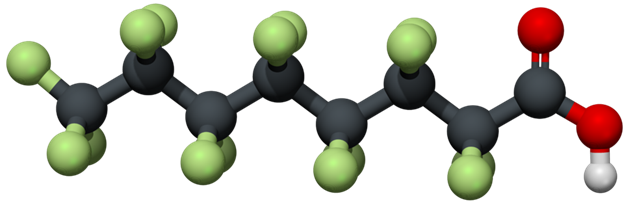
perfluorooctanoic acid (PFOA) molecule looks like a robotic caterpillar
Stringing it out: PFOA & PFOS
In 2024 the Biden EPA set aggressive 4 parts per trillion (ppt) contaminant limits for PFOA and PFOS under the Safe Drinking Water Act (SDWA), requiring water systems to meet the new standard by 2029. This month the Trump47 EPA announced that it’s sticking with the 4ppt limit for those two substances. That’s not terribly surprising; PFAS rule development started under Trump45, and Administrator Zeldin has been engaged on PFAS since his time in Congress. The SDWA’s anti-backsliding provision also requires EPA to “maintain or provide for greater protection,” and so effectively prohibits the agency from loosening those standards. But! EPA extended the compliance deadline for the PFOA and PFOS rules to 2031, so water systems will have two more years to get under the new limits.
I’m generally skeptical, bordering on cynical, about extended timelines for compliance with environmental rules. Seemingly well-intentioned forbearance can stymie enforcement in ways that frustrate or undermine the protections that regulations are supposed to provide.*
Howevah, extended timelines for PFOA and PFOS strike me as prudent. Comprehensive data from the Fifth Unregulated Contaminant Monitoring Rule (UCMR5) show PFOA and PFOS contamination above the 4 ppt contaminant limit in 6-7% of systems. A binary depiction of contamination as above or below that threshold masks stark disparities in contaminant levels. Check out the distribution of PFOA and PFOS levels:
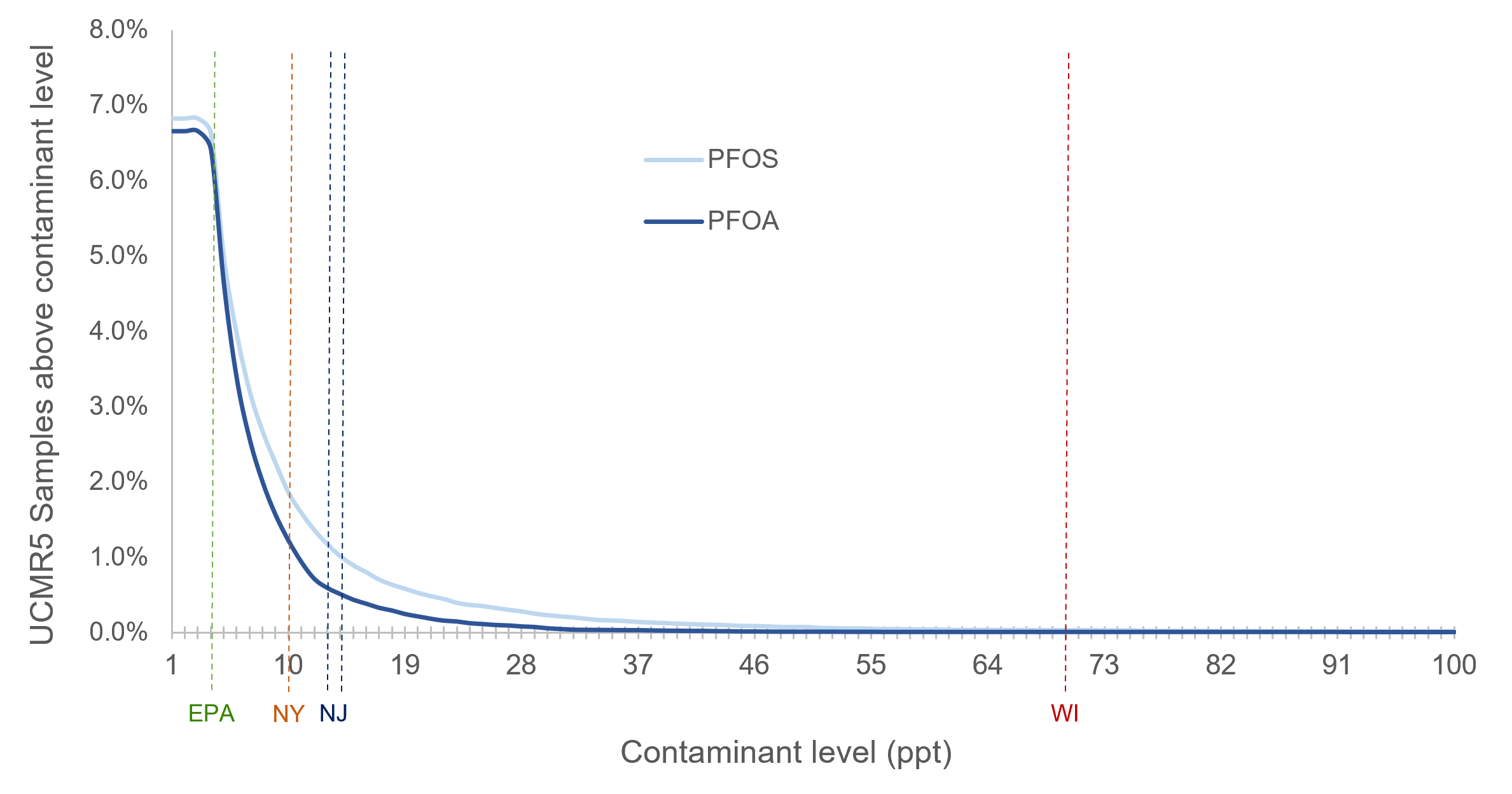
Dashed lines indicate binding maximum contaminant limits
That's a steep curve with a loooooooooooong tail, man. The share of PFOA and PFOS samples above the threshold would drop dramatically if the contaminant limit were set a tiny bit higher. For reference, only about 1.2% and 1.9% of UCMR5 samples exceed New York’s 10 ppt limit for PFOA and PFOS, respectively. By New Jersey’s standards (14 ppt for PFOA, 13 ppt for PFOS), the shares are 0.5% and 1.2%. A tiny fraction of a percent of samples exceed Wisconsin’s 70 ppt limit.
I’m no toxicologist, but I’m guessing that those systems in the long tail of that chart face the most significant PFAS-related health risks. With the extended timeline, EPA and state primacy agencies can prioritize fixes to systems where PFOA/PFOS levels are greatest. The added time also will allow supply chains to ramp up and drive down treatment costs as more utilities get advanced filtration and disposal processes in place. The eight states that set enforceable PFOA/PFOS limits before EPA moved are ahead of the curve here. Many severely PFAS-impacted communities in Wisconsin have already tackled the problem, for example.

perfluorobutanesulfonic acid (PFBS) is off the regulatory menu
Hazard Index goes bye-bye
The other major PFAS announcement is that EPA is dropping the Hazard Index from the PFAS rule. The Hazard Index was a novel approach to regulation for four additional compounds: rather than setting maximum contaminant levels (MCLs) for PFHxS, GenX/ HFPO‑DA, PFNA, and PFBS, the rule applied a formula that evaluated the four PFAS in combination.
Opponents of the Hazard Index mounted a series of legal and scientific arguments against it. The core legal arguments are that EPA didn’t follow the SDWA-mandated sequence for rulemaking, and that the Hazard Index violates the SDWA requirement of separate determinations for each contaminant. Scientific critiques focused on uncertainties around the layered and interactive effects of the Hazard Index’s four constituent compounds. I lack the legal and toxicological expertise to opine on the merits of these arguments.
Still, as a matter of public policy the Hazard Index approach strikes me as a good idea. Human bodies and the environment are complex systems; surely contaminants interact in ways that can drive health risks that are greater (or lesser!) than the sum of their parts. Holistic assessment of cumulative and combined risks from multiple contaminants seems sensible in cases where science supports it. If the SDWA’s statutory language requires assessing individual contaminants in isolation, then an amendment might be in order.
For now, dropping the Hazard Index will have little immediate practical effect, if only because exceedances are vanishingly rare. Fewer than 100 sampling sites in UCMR5 had Hazard Index values above the regulatory threshold—almost all of which were driven by high PFHxS levels. It appears just a handful of systems nationwide generated results that would have triggered a violation under the Hazard Index.** Odds are those systems’ managers are aware of and moving to address the problem.
UCMR5—FTW!
UCMR is EPA’s long‑running program for systematically tracking emerging drinking‑water contaminants before they are formally regulated, and it has grown more sophisticated with each cycle.

balloon kangaroo: unregulated… for now
Early rounds tested a handful of chemicals at a limited number of convenient-to-study systems; later rounds of UCMR expanded and enhanced national coverage, analytical methods, and contaminant scope. UCMR5 is by far the most ambitious and valid version yet, covering thousands of water systems for a representative national sample, applying new analytical methods, and generating the most comprehensive national PFAS dataset ever assembled.
Just as important, EPA made the UCMR5 data exceptionally easy to download, analyze, and interpret. UCMR5 data are already yielding important findings; researchers will continue to mine that vein for years. As someone who spends a lot of time analyzing data generated by federal agencies, I can declare with confidence that UCMR5 provides a level of transparency and usability that stands out across the EPA programs.
I give the EPA a lot of crap, so it’s only fair to give the agency its flowers, too. Nice job, EPA.
*The textbook example of regulatory negation-by-delay is the Boiler MACT rule under the Clean Air Act. Congress required EPA to issue air pollutant standards for industrial boilers by 2000, but due to litigation, administrative delays, and repeated deadline extensions the rule didn’t meaningfully take effect until the mid‑2010s.
**Hazard Index exceedances were so rare in UCMR5 that Mike Powell, David Switzer and I couldn’t analyze their social correlates in the new book.