
Strengthening trust in tap water—and in government—means taking aesthetics seriously
the ultimate consumer confidence indicator (Photo by Engin Akyurt)
A great irony—and in some ways, a great tragedy—of the Safe Drinking Water Act (SDWA) is that it accidentally created a compliance culture in the American water sector. Rather than chasing excellence, utilities seek to avoid rate increases and to follow rules. The SDWA’s legally binding, primary drinking water rules are about protecting human health: the law sets maximum contaminant limits and requires treatment technologies that protect consumers from toxins. The SDWA’s main goal is to make water safe to consume—not pleasant to consume.
Turns out that there are lots of contaminants that don’t necessarily make water unsafe, but can make it look, smell, and taste bad. Hard water leaves scaling on fixtures and tastes odd, for example. Iron makes water appear rusty and leaves oranges stains. Chloride gives water a vaguely salty taste. These substances that affect tap water aesthetics are called secondary contaminants, and the SDWA regulates them too… kind of. EPA set standards for a suite of secondary contaminants but they’re not enforceable. A new Journal AWWA article notes that secondary contaminant limits were set way back in 1979 and argues persuasively for updating them in light of scientific advances on tap water aesthetics.
Thing is, SDWA aesthetic standards aren’t rules, they’re suggestions. And as the name suggests, water aesthetics are largely an afterthought in utility policy, management, or investment decisions. That’s unfortunate, because when it comes to trust in tap water—and trust in the organizations that deliver it—people believe their eyes, noses, and tastebuds, not their federal Consumer Confidence Reports.
Taste and trust
The central argument in Profits of Distrust is that people’s experiences with basic services shape their trust in government, and that the meteoric rise of the bottled water industry reflects to a great degree a concomitant decline of trust in the institutions charged with regulating and providing water in America. Marshaling national survey data, we showed that bottled water consumption increases and trust in government falls when people experience problems with their tap water like low pressure, main break, cloudy water, and so on.
Since publishing Profits, I’ve continued to analyze all kinds of data on service quality, drinking water behavior, and trust. The single most consistent thing I find everywhere I look is that people who don’t like the taste of their tap water turn to bottled water and—crucially—express less trust local government. Let’s look at data from three different surveys of different populations that asked similar questions about tap water, bottled water consumption, and trust.
Here’s the probability of drinking bottled water at home for people who never, rarely, occasionally, or frequently experience bad tasting tap water, with data from the U.S. Water Alliance’s 2021 Value of Water survey of U.S. adults (N=970):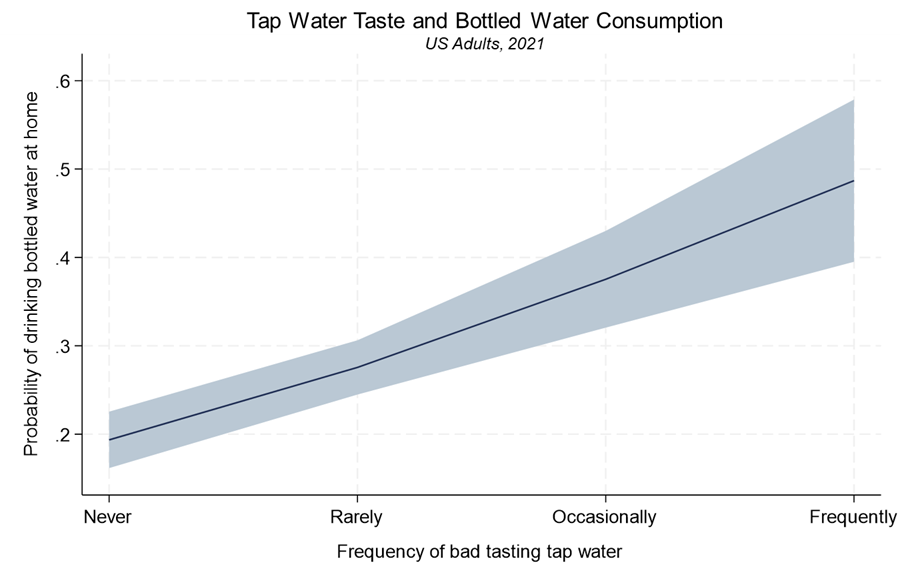
Regression estimates, adjusted for respondent age, sex, race, ethnicity, and partisanship. Shaded areas represent 95% confidence intervals.
People who never experience bad-tasting tap water have about a 17% probability of drinking bottled water. That probability jumps to nearly 50% for those whose tap water frequently tastes bad. Now let’s look at the same analysis applied to trust in government:
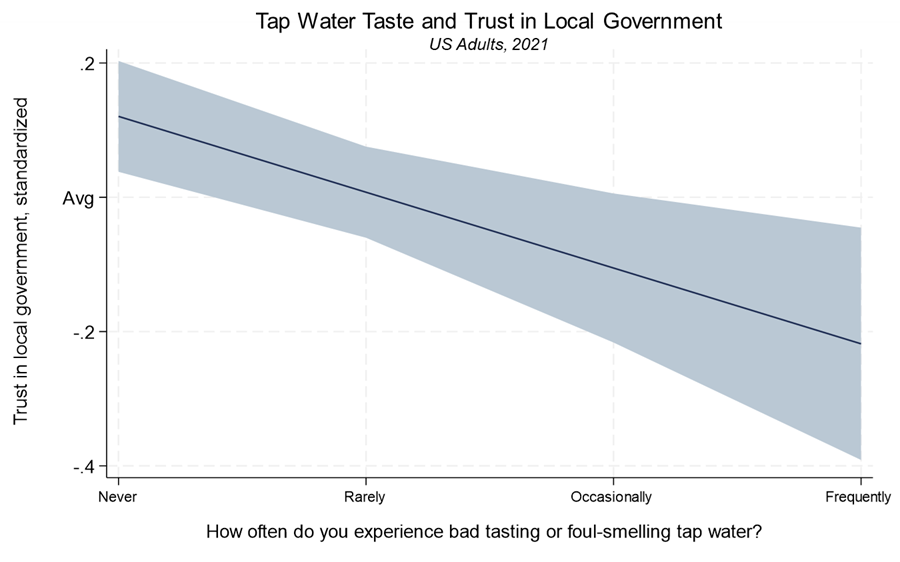
Regression estimates, adjusted for respondent age, sex, race, ethnicity, and partisanship. Trust in government standardized (average = 0, standard deviation= 1). Shaded areas represent 95% confidence intervals.
Trust in local government is about +.10 standard deviation above average for people whose tap water never tastes bad, and about -.20 for people whose water frequently tastes bad.
In 2024 I fielded a series of surveys about water in four small Wisconsin towns, all of which have municipal utilities that boast strong overall performance and excellent SDWA records. My Wisconsin surveys (total N=2,260) asked water experience and behavior questions similar to the US Water Alliance’s. The results were strikingly consistent with theirs, too. Here’s bottled water consumption:

Regression estimates, adjusted for respondent age, sex, race, and ideology. Shaded areas represent 95% confidence intervals.
Wisconsinites whose tap water never tastes bad have just a 10% probability of drinking bottled water at home, but the probability is over 50% for those whose tap water very often tastes bad. An even more dramatic relationship between tap water taste and trust in government relationship shows up in the Badger State:
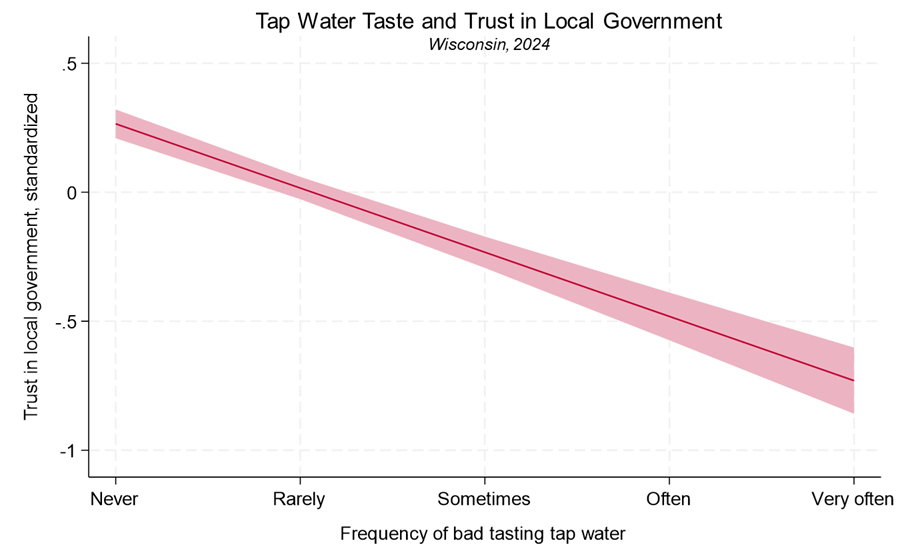
Regression estimates, adjusted for respondent age, sex, race, and ideology. Trust in government standardized (average = 0, standard deviation= 1). Shaded areas represent 95% confidence intervals.
Experiencing bad-tasting water often correlates with more than a .5 standard deviation decrease in trust in local government. That’s large.
But maybe most startling of all are the results of a new CivicPulse survey of 500 municipal elected officials across the country. Here’s tap water taste, bottled water consumption and trust in government for America’s city councilmembers—you know, the people who govern municipal drinking water:

Thin bars represent 95% confidence intervals.
When it comes to drinking water, local elected officials apparently aren’t so different from the people who they represent. If the people who govern municipal water don’t drink from the tap because it tastes bad, it shouldn’t surprise us that their constituents don’t, either.*
Taking taste seriously
Most Americans wake up in the morning and interact with their local governments when they turn on a tap; how they feel about what comes out of that tap reveals a great deal about them as consumers, and as citizens. Aesthetics might be secondary to the SDWA, but they’re paramount to customer perceptions. For the people who run, regulate, and govern water systems, strengthening public trust requires prioritizing aesthetics. The ultimate affirmation of consumer confidence is a glass of water that’s genuinely enjoyable to drink.
The part where Manny chats with himself

Does that mean EPA should set
enforceable rules for aesthetics, too?
No. The SDWA only authorizes binding limits for contaminants that are potentially hazardous to human health. That’s probably sensible when it comes to federal regulation.
So...why should a utility worry about
taste if regulators don’t care?
Regulations aren’t performance goals, my dear electronic alter ego. Complying with primary contaminant limits is the minimum expectation. A utility that values its customers’ trust ought to strive for more than not making them sick. Water that looks, smells, and tastes great will do more for public confidence than any CCR or public relations campaign.
But treating water to fix aesthetics might be expensive!
Don't you care about affordability?
The fraction of a penny per gallon that it would cost to treat hardness at the wellhead is a steal compared with the cost of installing and maintaining a water softener—to say nothing of bottled water. If we can move the needle on bad-tasting water from frequent or often to rarely or never, we can drive down bottled water consumption by perhaps 75%. That’s hundreds or thousands of dollars back in customer wallets—especially for the low-income households that drink the most bottled water.
 Whoa.
Whoa.
You mean more expensive treatment is going
to help low-income affordability?
Improving aesthetics might be the most powerful, effective way for utilities to improve low-income affordability. If the bill goes up by $5 a month but the bottled water budget drops by $100, the customer comes out $95 ahead. Better aesthetics means better affordability.
Nothing is stopping utilities from fixing aesthetics.
Why don’t they?
I dunno, man. Probably rates and politics, as usual. Taste complaints are scattered and they don’t often reach elected officials. Complaints about rate increases are concentrated and hit city councils full-blast.
Who wins if utilities everywhere prioritize aesthetics?
Treatment technology firms.
People who drink water.
The planet.
And losers?
Bottled water manufacturers.
Point of use filter companies.
Water softener salesmen.
Dude.
You know what would be awesome?
Nacho cheese-flavored tap water!

*Those who govern water ought to eat their own dog food. Get the Dasani bottles out of the city council chambers!
Many of the things mentioned here are well accepted facts. There's a twist in the tale though. Taste is a parameter that is very difficult to attribute to specific causes. What one may find tasteful the other may find not so. Also water softener does not improve taste and its output is not exactly recommended to be drunk.
Its a complex problem that starts with disinfection of water by chlorination and other oxidative substances. Their removal at source means that water is conveyed without residual protection.
The eventual price paid for a health outbreak by population and also a city council or a Municipality is far greater than that incurred by a set of individuals intent on getting tasty water.
I recall being taught in early chemistry classes that water is a tasteless, odorless, sterile liquid. Everything that imparts taste or health risk is an add-on.