
Maybe engineers really are better at managing water utilities*

if Hogwarts had an engineering school
Does a utility leader’s education matter for the performance of his/her utility? Recently I wrote about the academic backgrounds of the chief executive officers (CEOs) who lead America’s water utilities. A key takeaway from that post was disciplinary diversity: about half of water’s top leaders hold engineering degrees, but the rest come from a wide range of other other academic fields.
In this post we’ll look at the relationship between academic background and utility performance, with a key management indicator: compliance with the Safe Drinking Water Act (SDWA). Turns out that there’s a degree of difference between utilities that have an engineer in the corner office and those that do not.**
Why CEOs matter
Before diving into the data, it’s worth taking a moment to understand why a CEO’s academic background might matter for SDWA compliance. The top executive is just one person, and in all but the smallest utilities (s)he isn’t directly involved in utility operations. The chief executive’s tasks are planning, organizing, staffing, directing, coordinating, reporting, and budgeting. So why would a CEO’s disciplinary training matter for SDWA compliance (or any other performance measure, for that matter)?
The answer is Upper Echelon Theory: the idea that an organization’s strategic choices and performance reflect its top manager's personality, values, experiences, and cognitive biases. The theory suggests that these personal factors shape the way executives make decisions, ultimately influencing their organizations' directions and outcomes. According to Upper Echelon Theory, a CEO’s academic background matters not because of specific skills or knowledge, but rather because a disciplinary degree connotes a certain set of values, priorities, and way of understanding the world. A leader’s academic background tells us something about lenses through which (s)he sees things and determines his/her organization’s strategic path. Effective leaders inspire a shared vision within their organizations; Upper Echelon Theory tells us something about that vision.
A recent meta-analysis of research on public agencies links executives’ academic disciplines to their organizations’ performance: specialized education correlates with greater field-specific performance, while generalist education correlates with better financial performance.
Engineers as utility executives
Applied to water, Upper Echelon Theory suggests that executives who are engineers will manage water utilities differently from non-engineers. For professional engineers, prioritizing professional values means systems analysis and technology-based solutions. In a 2014 article I argued that the SDWA casts tap water safety in engineering terms: a technical problem that demands technical solutions. According to Upper Echelon Theory, SDWA compliance should be stronger for utilities led by engineers compared with non-engineers. The argument isn’t that CEOs with engineering degrees are smarter or care more about public health or environmental quality compared with non-engineers; the argument is about the engineering values embedded in the SDWA itself. Many SDWA rules demand observable and quantifiable adherence to technical procedures designed by engineers and reflecting engineering principles. A CEO who imbues his/her organization with engineering values is likely to excel in meeting such requirements.
Testing that hypothesis, that 2014 study showed that SDWA compliance indeed was stronger for utilities whose CEOs held engineering degrees—a finding that inspired self-satisfied smirks from engineers and annoyance from non-engineers.
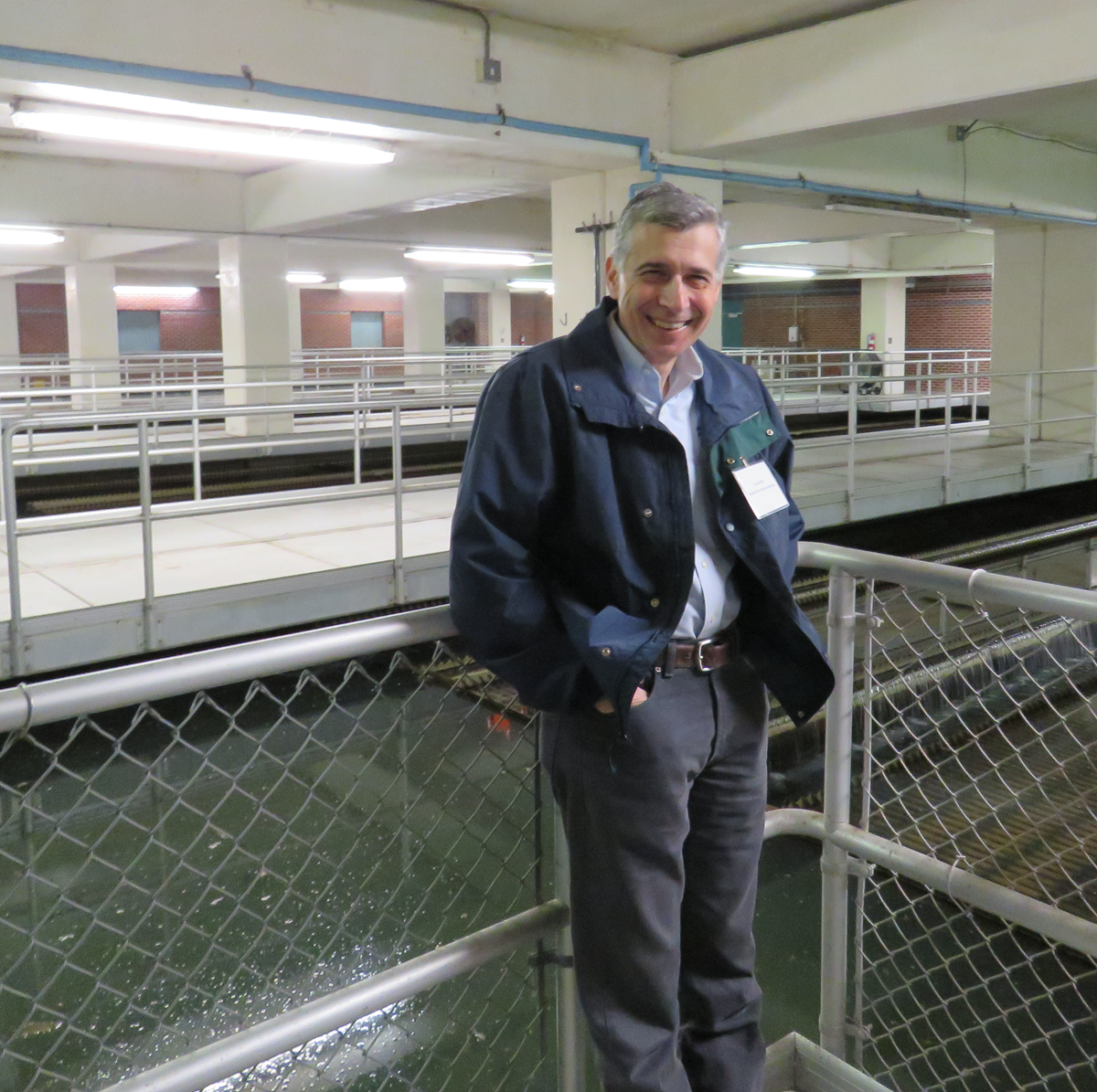
Anthony Bellitto: the engineer in charge at NPWA, which has perfect SDWA compliance.
Fresh analysis: SDWA compliance by CEO education
A key limitation to my 2014 study was a relatively small dataset with little variation in academic discipline; we could compare engineers to non-engineers, but not much more. The updated, much larger CEO dataset Natalie Smith and I crafted in 2023 boasts more disciplinary diversity, which allows a fresher, sharper test of Upper Echelon Theory. Do utility violations of the SDWA vary systematically by the academic backgrounds of their CEOs?
To answer that question, we matched our data on CEO backgrounds to ten years’ worth of SDWA violations data. We isolated the violations that occurred during each CEO’s tenure so an executive only got credit (blame) for compliance (violations) while (s)he was in charge. Our analysis focuses on management (that is, non-health-related) violations of the SDWA because health-related SDWA violations fortunately are pretty rare. More importantly, management violations involve things like monitoring and reporting rules, which are entirely organizational. That makes SDWA management violations a clearer indicator of CEO impact than health-related violations. I then fit statistical models that estimate the number of SDWA management violations during a CEO’s tenure by his/her academic background, after adjusting for the length of time on the job, as well as utility size and ownership.
The results will do nothing to deflate the egos of those self-satisfied engineers, I’m afraid. This graph shows the average number of added (or reduced) SDWA management violations associated with a CEO’s academic discipline or degree, compared with a generic undergraduate degree†:
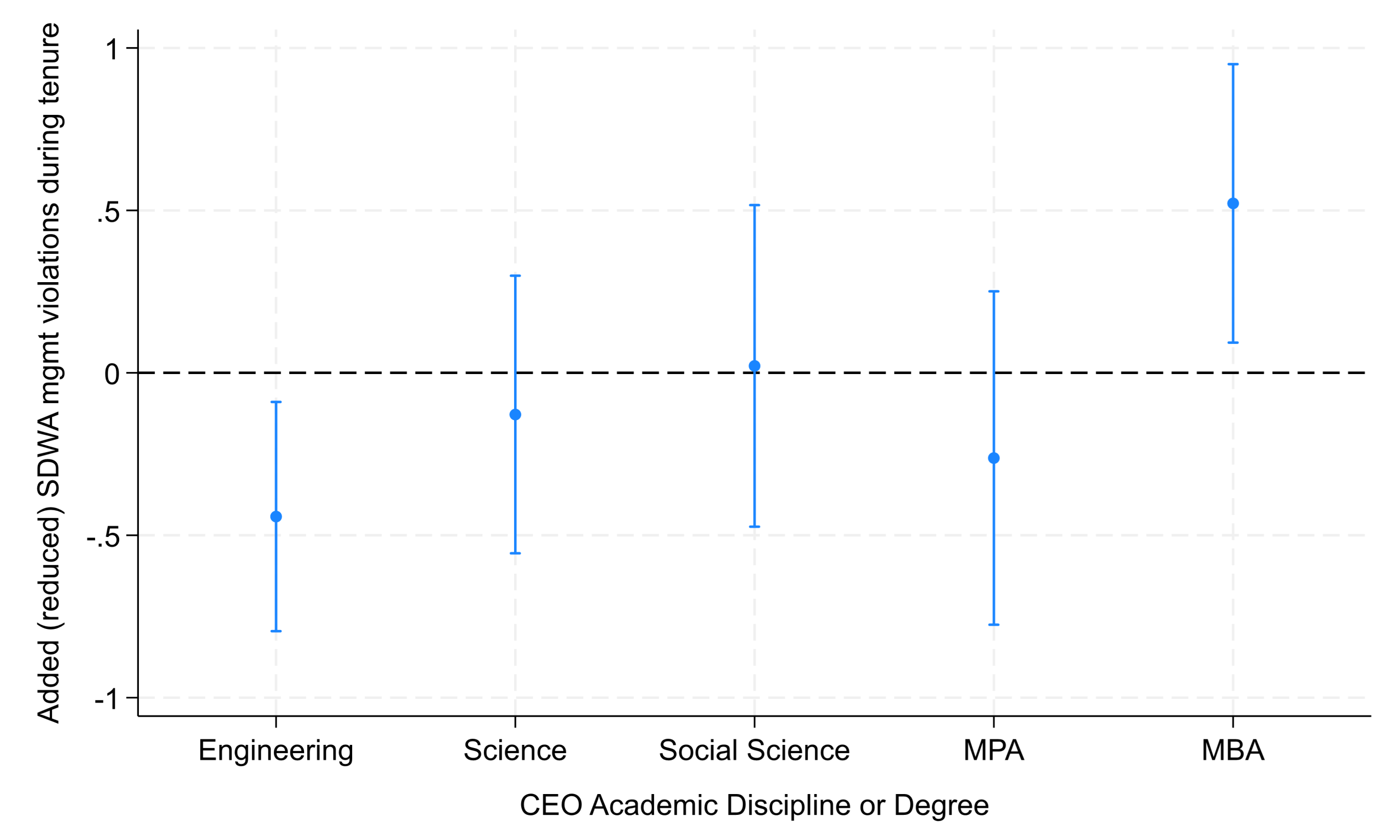
Estimates from negative binomial regression, adjusted for size, ownership, and CEO tenure. N=767. Points below the dashed line indicate fewer SDWA violations; points above the dashed line indicate more SDWA violations.
Compared with a generic college graduate, there’s no significant difference in SDWA compliance associated with science or social science degrees in the executive suite. But utilities that have an engineering graduate as CEO commit an average of .47 fewer violations over a five-year period. It’s unlikely that this difference is because CEOs with engineering degrees are drawing water samples, filing paperwork, designing Consumer Confidence Reports, or doing any of the other things that SDWA procedures require. It’s more likely that an engineer in the corner office prioritizes technical processes and fosters an organizational culture that values SDWA compliance. For leadership, it’s engineering values that matter, not engineering skills.
The part where Manny chats with himself

woah. does that mean engineers are better executives?
It means that SDWA compliance is better when engineers are in charge. That’s only one measure of utility performance.
but it’s an important one, right?
Clearly.
But keep the context in mind: 60% of the utilities in this analysis had perfect compliance and that 88% had perfect compliance with SDWA health-related rules.
CEO education matters, but it matters at the margins.
um what’s up with MBAs  ?
?

Yeah not great. On average, utilities where the top executive has an MBA violate SDWA management rules significantly more frequently than those without one. Here’s estimated violations during the CEO’s tenure for MBAs without engineering degrees vs. those with engineering degrees and no MBA:
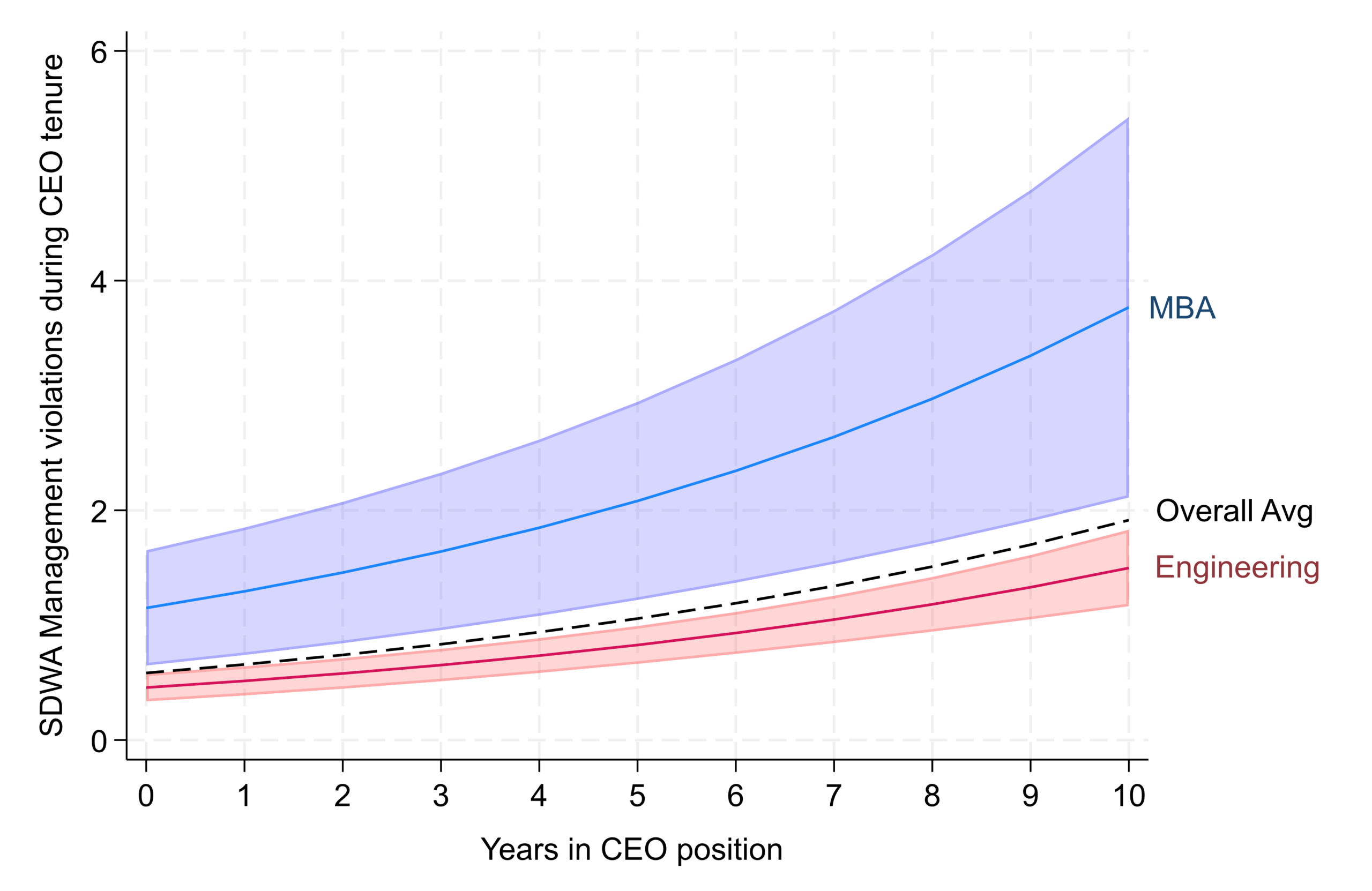
That's an average of nearly four violations over ten years for a non-engineer with an MBA compared to about one violation for an engineer without an MBA.
wow MBAs really suck
That’s not fair, my snarky electronic alter ego.
Upper Echelon Theory tells us that business administration is a different profession with different values. Based on past research, I’d guess that utilities with MBAs in charge have better average financial performance and personnel management. Alas, I don’t have the data on that stuff.
Also, remember that the majority of utilities led by MBAs have great SDWA compliance.
how about engineers who have MBAs?
Good question—lots of water CEOs have both degrees. Analysis indicates that, at least in statistical terms, the effects of engineering education and MBAs are independent. On average, engineer CEOs commit fewer violations (with or without an MBA) and MBAs commit more violations (with or without an engineering degree).
what does that mean for selecting a CEO?
It’s all about priorities. Exceptionally talented executives can excel in lots of areas, and I suspect that many of the engineers who lead utilities are simply very talented people.
But no leader can prioritize everything all the time. Financial strength, personnel management, sustainability, communication, and other areas of performance might not be as strong in a utility that prizes technical prowess above all.
But there’s no getting around it—engineers apparently do a great job with SDWA compliance.bro i can’t believe you published this
engineers are already insufferable know-it-alls
Don't have to tell me, dude. I’m married to an engineer and father to another. Some of my best friends are engineers, and I work with them all the time. I'm never going to hear the end of it.
Brace yourself for self-congratulatory snickering in exceedance of the MCL for smugness. is there any antidote?
Nope. Best just to sigh and roll your eyes...
…then thank an engineer for making the world safer. 
*When engineering principles define “better”
**See what I did there?
†For the statistically inclined, the omitted reference category is degrees in all other fields.